By Nan Corbitt Allen
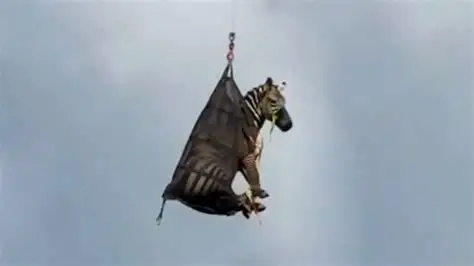
I first saw it on the local news. A pet zebra had escaped from its owners’ fenced back yard and was at large somewhere in rural Middle Tennessee. The six-day search for “Ed” netted almost nothing. A few sitings of him dashing into the woods after running along an interstate were amusing but no one had been able to capture and return him to his people.
Finally, someone was able to corral him, and a helicopter was summoned to harness him and fly him out of the woods. Imagine you were driving in rush hour traffic and you saw this spectacle. I’m sure there were motorists who drove directly to an AA meeting where they reported what they saw and swore that they were sober. Others may have renewed their Prozac prescriptions. And…who knows, some of them may have even gotten saved.
Recently, I heard about a book entitled Why Zebras Don’t Get Ulcers. I read some of it and the premise is that animals don’t get anxiety attacks or …ulcers apparently. The book isn’t written by a believer. The author is a professor of biology and neurology at Stanford University.
He explains his theory and reports his research about this by showing how stress affects the human body and why chronic stress can contribute to illness. A zebra running from a lion experiences enormous stress—but usually only for a short time. Its body releases stress hormones, mobilizes energy, raises heart rate and blood pressure, and temporarily shuts down functions that aren’t immediately necessary for survival. When the danger passes, the zebra’s stress response switches off.
Humans, he notes, have the same basic biological stress system, but we can activate it without an immediate physical threat. We worry about tomorrow, replay yesterday’s problems, anticipate conflict, think about money, work, relationships, health, and countless other concerns.
The author says that a zebra generally doesn’t spend its evenings thinking:
“That lion nearly caught me. What if he’s there tomorrow? Maybe I’m getting slower. What if the herd leaves me behind?”
We’re told by Jesus not to worry. He says in Matthew 5, “I tell you, do not worry about your life, what you will eat or drink; or about your body, what you will wear. Look at the birds of the air; they do not sow or reap or store away in barns, and yet your heavenly Father feeds them. Are you not much more valuable than they?”
Easier said than done, isn’t it? How do we switch off the anxiety when it appears?
Here are some suggestions:
- Christians, “do not worry” doesn’t mean pretending problems aren’t real. It means refusing to let fear of what might happen control us because we trust the God who is already present in what is happening.
- Remember who is taking care of you. Jesus points to the birds and flowers. If God cares for His creation, how much more will He care for His children? Worry asks, “What if everything goes wrong?” Faith asks, “Even if things are difficult, will God still be with me?”
- Stay in today.
Jesus says, “Do not worry about tomorrow, for tomorrow will worry about itself” (Matthew 6:34, NIV). Much of our anxiety comes from mentally living in a future that has not happened. - Turn worry into prayer.
Paul writes, “Do not be anxious about anything, but in every situation, by prayer and petition, with thanksgiving, present your requests to God” (Philippians 4:6, NIV). When worry returns, make it a signal to pray. - Focus on what you can do and entrust the rest to God.
Trusting God isn’t passivity. If there is something responsible you can do today, do it. But when you reach the point where the outcome is beyond your control, recognize that God never asked you to control it in the first place. - Seek God before seeking certainty.
Jesus concludes, “But seek first his kingdom and his righteousness” (Matthew 6:33, NIV). Peace doesn’t necessarily come from knowing what will happen. It comes from knowing who holds us when it happens.
The goal isn’t necessarily to never feel worried. The Christian practice is to keep handing the worry back to God whenever it returns.
So, if you look up one day and see a flying zebra, don’t worry. He’s not worried about a thing.
Sweet picture of a a deep truth!
Amen to all of this! I think it takes practice and discipline to keep turning it over to God. I’ve never been good at those two actions but I’ll keep trying! Love you!
Nan, I love the “non-worried zebra” story! This is the exact thing I was discussing with my boss today, minus the flying zebra, of course! God holds us together by His Word and sometimes He uses His children to remind us just how much He will hold us still! Keep looking up for the flying zebras!
One of your best!!!